
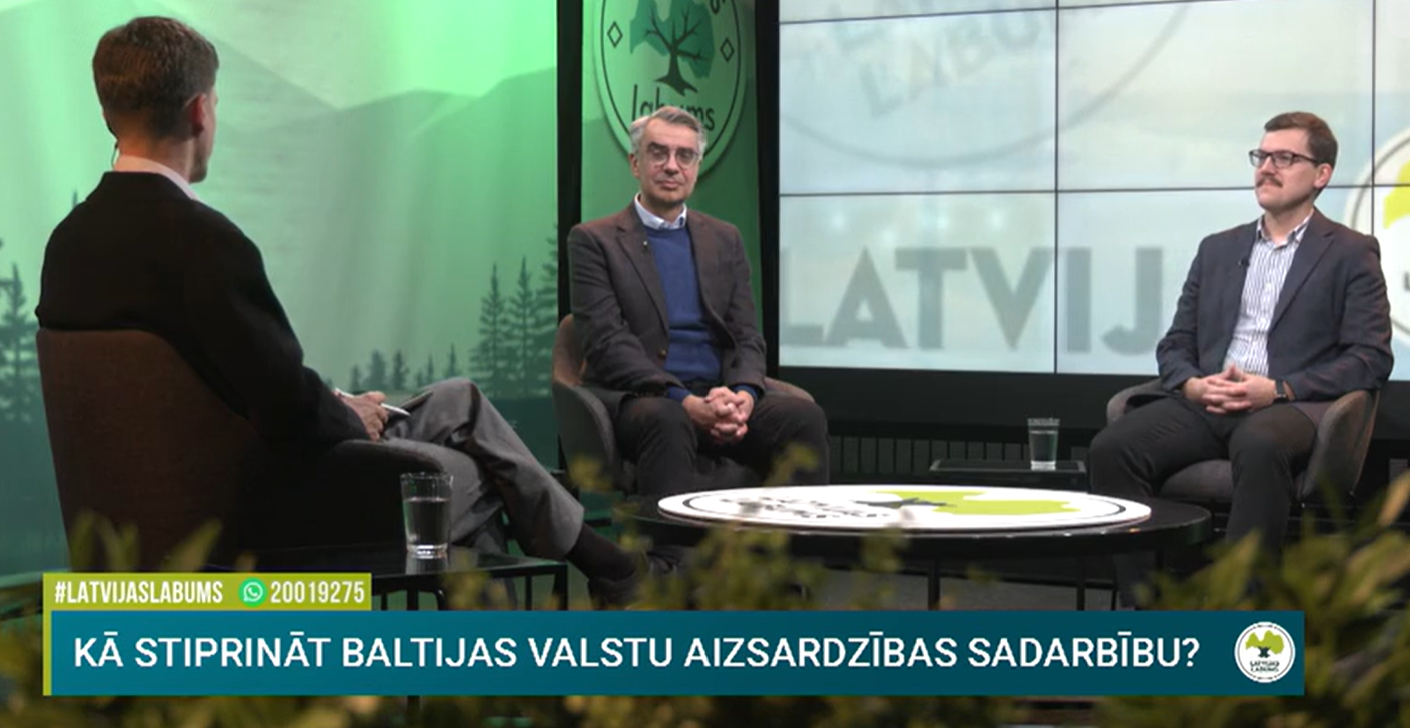
LaSER researcher Roberts Kits and Chair of the Board Daunis Auers appeared on the TV24 programme “Latvijas labums”, organised by the Latvian Chamber of Commerce and Industry (LTRK), to discuss the potential of Latvia’s defence industry, opportunities for deeper Baltic cooperation, and the region’s competitiveness in a changing security environment.
The discussion centred on LaSER’s recently published policy report, Towards the Baltic Tiger: Strengthening Defence Cooperation Among the Baltic States, which builds on the think tank’s earlier work on Latvia’s long-term development scenarios. The speakers argued that the Baltic Tiger vision is not based solely on strengthening defence capabilities, but also on economic growth, innovation, and regional integration. As Daunis Auers noted, the Nordic welfare model was built only after internationally competitive companies had created the economic prosperity needed to support long-term social investment.
The programme also highlighted how the planned increase in defence spending to 5% of GDP creates new opportunities for businesses. At the same time, the discussion emphasised that security extends far beyond military capabilities. Civil protection, critical infrastructure, military mobility, and closer cooperation between the Baltic defence industries are becoming increasingly important components of regional security.
The speakers also reflected on Latvia’s position within the Baltic region. While Lithuania has recently overtaken Latvia on several economic indicators, Daunis Auers argued that Riga continues to possess significant metropolitan potential, particularly through stronger cooperation with Helsinki, Stockholm, and other Nordic cities. At the same time, they noted that the Baltic states are both partners and competitors, and that closer regional cooperation does not necessarily produce equal benefits for every country, but can strengthen the competitiveness of the region as a whole.
As a practical example of regional integration, the discussion highlighted the need to reduce administrative barriers for businesses operating across the Baltic states. One proposal was to enable companies to register simultaneously in Latvia, Lithuania, and Estonia, creating easier access to a regional market of approximately six million people and supporting closer economic integration.
The programme concluded with a discussion on the changing international security environment and the need for smaller states to adapt to a geopolitical landscape in which economic resilience, regional cooperation, and the joint development of strategic industries are becoming increasingly important.
The first and second parts of the programme are available to watch here.
Foto: Play24.lv